Pages

Tuesday, 11 October 2016

Simos PCR 2.1 high-pressure pump engine management system

Introduction
In diesel engines of the VAG group, in the 1.6 CAYC version , this electronic management system for injection of fuel is carried out using a Simos PCR 2.1 Continental Common Rail System. The high pressure pump is driven by the timing chain and the injectors are the piezoelectric type. The engine control unit controls and regulates the fuel pressure and dose. In this chapter we will discuss the high-pressure pump. 


High pressure fuel pump
This is fixed on the front right hand side of the engine and is driven by the timing belt. It is a two piston pump that works with maximum pressures of 1600 bar.

Wednesday, 5 October 2016

Towards sustainable transport

With the arrival of electric vehicles, it was suggested that developments in the sector to leave fossil fuels behind would take this line.

The biggest disadvantage is the range which these vehicles have at this time, and in the infrastructures that the different administrations provide to equip cities and roads with battery-charging stations.


Siemens (the German industrial and technology group) jointly with the Swedish lorry manufacturer Scania, will build the first electrical highway in Sweden.

With the objective of reducing dependence on fossil fuels for transporting goods by road, the Swedish Transport Administration awarded the contract to the County of Gävleborg.
The cost of the project is more than 9 million dollars of which almost 6 will come from private investment.


Wednesday, 28 September 2016

The engine does not start: Immobiliser or key error

Our Department's review of incidents has confirmed a curiosity that affects the whole range of models of Volkswagen fitted with the immobiliser-transponder system. 

DTCs are recorded with immobiliser fault and key signal not identified. Various symptoms in the performance of the vehicle's engine are added together with these fault codes.

Below are detailed all the symptoms that appear: 


VW logo.


-P0513 - Incorrect code of the immobiliser.

-P1177 - 1177 - Key, signal not plausible.

-Engine does not start occasionally.

-Warning message on the instrument panel display which states the following: “Immobilizer enabled".


NOTE: This technical note only affects vehicles fitted with a transponder-immobiliser system. 


Tuesday, 20 September 2016

Volkswagen Group, 1.6 CAYC diesel engine, exhaust gas recirculation system - EGR.

Diesel engine 1.6 CAYC
Technical specifications.
• 4 cylinder, 1,598 cm³ turbo-diesel engine developed by the VAG group.
• The engine has a double overhead camshaft and 16 valves.
• Common rail direct injection system with piezoelectric injectors.
• Charge air system with variable geometry turbocharger and intercooler.
• Catalytic converter with particulate filter.
• EGR solenoid valve with exhaust gas recirculation cooling.
• Meets Euro 5 anti-pollution standard.


Torque and power curves:


Exhaust gas recirculation EGR.
The purpose is to reduce nitrogen oxide emissions. A part of the exhaust gases are fed back into the combustion process. The engine control unit regulates the flow of recirculated exhaust gases, while taking into consideration the engine speed, the amount of aspirated air, the aspirated air temperature, amount injected and air pressure.


Tuesday, 13 September 2016

Tensioning of the parking brake in the BMW 1 Series and 3 Series


In this post, instructions as provided by the brand are given for correctly tensioning the parking brake in the 1 series and 3 series BMW.
This process affects the following bodies:

1 Series: E81, E82, E87 and E88.
3 Series: E90, E91, E92 and E93.


Note:

The hand brake must be adjusted if:
• The parking brake shoes or other parts in the assembly are replaced.
• The brake discs are replaced.
• Excessive travel (10 teeth).
• Renewal of the parking brake Bowden cables.

Tensioning process

First, detach the hand brake lever bellows. It is recommended to use plastic levers so as not to damage the vehicle's interior.
Lever the points indicated in the images to disengage the bellows and extract them over the lever.


Tuesday, 6 September 2016

P2294 fault codes recorded in the AUDI TT

From our Call Centre, we have been able to confirm the repetition of several faults in the Audi TT, where a code relating to the fuel pressure has been recorded.


• 08852 – P2294 – Fuel pressure regulating valve (N276). Interruption.
• 18726 – P2294 – Fuel pressure regulating valve (N276). Interruption.

In this case, the displayed fault code reading from the engine control unit will be fault code P2294 but, depending on the diagnostic tool used, it is possible that a decimal code will be recorded that may match the two options we give.

The Malfunction Indicator Light (MIL) is on due to a fault in the fuel circuit and there is a considerable lack of power.

The cause of this fault is a failure of the power supply of the fuel pressure regulating valve (N276), which comes from the engine component relay (J757).

To properly repair this fault, take the following steps:

- Check the electrical connection of the fuel pressure regulating valve and its power supply.

Thanks to our dis-net tool, we can access the engine diagram, the location and the monitoring of values of the fuel pressure regulating valve as shown in the image. 


Engine diagram. www.dis-net.com platform / Check on the N267

Wednesday, 31 August 2016

New concepts: new engines

The research carried out in recent years by petrol engine manufacturers has focussed on the battle to lower CO2 emissions (considered a cause of global warming).
Compliance with the magic figure of 130 gr/km valid until 2020 has got the engine development departments working flat out. This figure is the only one that has led to a radical rethink of the modern engine, as the Euro 4 to Euro 6 standards do not significantly differ as regards the polluting gases measured for approval (CO, HC and NOx).

The Lambda 1 petrol engine is a high generator of CO2, in fact in the catalytic converter two oxidations and a reduction occur, CO2 being a large part of the results.


Today, the only way to reduce CO2 emissions lies in reducing consumption. At the moment there is no system or device that assists the engine in lowering this emission.

Thursday, 18 August 2016

Types of active suspension (l). Hydroactive 3 for Citroën C5

In an ideal suspension system, the position of the wheels would not change with respect to the body. The purpose of the various active suspension systems is to control the stiffness of the damping.

In hydraulic and air systems, the height of the vehicle is also controlled depending on variations in weight and road conditions. Electronic and electro-mechanical systems are required for this. In this and subsequent posts, three examples of this type of suspension are going to be described: the Citroen C5 Hydroactive 3, the Audi A8 Air suspension and the VW Golf DCC Adaptive Chassis Control.

In this first post, we are going to look at the Hydroactive 3 suspension.

Hydroactive 3 from Citroën C5

This type of suspension allows the distance to the ground to be varied automatically depending on speed. There are two positions, sport and comfort, which automatically change the stiffness of the damping. These changes give greater stability due to the lowering of the centre of gravity by 15 mm at the front and 11 mm at the back, which reduces fuel consumption. On poor roads, the system can raise the height of the vehicle by up to 13 mm.

Hydroactive 3 facilitates choosing between the two suspension options, it allows switching, alternately and in real time, from a soft setting, which gives priority to comfort, to a hard one to improve stability, while taking into consideration the driving style and the road profile at all times.

The main elements involved in the system are:

1. Integrated hydroelectronic block.
2. Front bearing elements.
3. Front stiffness regulator with its sphere.
4. Front height sensor.
5. Rear hydropneumatic cylinders
6. Rear stiffness regulator with its sphere.
7. Rear height sensor.
8. Control unit.
9. Steering angle sensor.
10. Hydraulic fluid tank.
11. Accelerator pedal position sensor.
12. Braking pressure sensor.
-A simplified hydraulic system.
 

Tuesday, 16 August 2016

The required and correct maintenance of the particulate filter (FAP)

In 2010, the Euro 5 standard came into force that requires car manufacturers to install a Particulate filter (DPF or FAP), among other elements, in the exhaust systems of diesel engines.
The purpose of the FAP is to store soot particulates generated by the incomplete combustion of the fuel, which drastically reduces the harmful particulate levels emitted to the atmosphere.

The FAP is a particularly effective mechanical filter which is made up of honeycomb type cells that trap the particulates emitted during combustion. It can retain more than 99% of the combustion particulates.


Particulate filter

To regenerate the Particulate Filter and prevent internal saturation with soot, the system carries out a regeneration process. This process is activated when certain technical temperature and running conditions are fulfilled. When these conditions are met, the engine control unit starts this process by acting on the injection system in order to raise the temperature inside the particulate filter, and thus burn the soot accumulated in it.

Tuesday, 2 August 2016

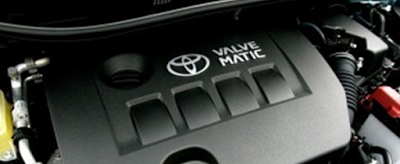
How does the Valvematic system work?

VALVEMATIC - INTAKE VALVE VARIABLE LIFT CONTROL TECHNOLOGY
The various car manufacturers’ race to develop systems to reduce emissions, consumption and increase performance of their engines has led the Japanese Toyota brand to develop its Valvematic intake valve variable lift control system.


The Valvematic system, in coordination with the VVT-i dual system (variable valve timing), carries out the continuously variable intake valve lift control, as well as controlling the actuation angle of the intake valve, the full opening of the throttle valve and the synchronisation of the intake valve in accordance with engine conditions. This improves engine performance and saves fuel. The intake valve lift varies between 0.09 mm and 11 mm in accordance with engine needs.

One of the particular features of this system is that the intake manifold throttle is fully opened (like a diesel) in order to reduce pumping losses at all engine speeds. The Valvematic system will act based on the information that the ECM (engine control module) has collected from the TDC (engine rpm) and NTC (coolant temperature) sensors, the exhaust and intake camshaft position Hall sensors, from the MAF (Mass Air Flow) sensors and from the intake throttle position sensor and through the EDU (servomotor control unit), and it will open the intake valves between the aforementioned 0.09 mm and 11 mm according to needs so that the engine runs at the speed required by the driver.

This system requires the use of a vacuum pump to provide the correct vacuum to control the brakes, this is because the throttle is fully open and there can be no difference in pressure between its faces.


Related Posts Plugin for WordPress, Blogger...